Welcome to your marching band parent guide, the quick-start handbook you’ll wish you had at the first call time. Whether you’re brand-new or finally ready to decode what “front ensemble needs power at side 1” actually means, this will help you navigate competitions, logistics, and the mysterious but mighty “Pit.” You’ll learn how a season unfolds, what to expect on show days, how scoring works, and how to keep your student healthy and on time. And yes, you’ll finally understand why everyone whispers during performances and why gaffer tape is basically a survival tool.
How Marching Band Season Works
Rehearsals, Camps, And Calendars
Your season starts with summer band camp, several long days of learning drill, music, and show choreography. Expect a high-volume schedule: daily blocks of music rehearsal, visual blocks for marching fundamentals, and full ensemble reps late in the day when the sun is lower. Once school starts, most programs rehearse 2–4 afternoons per week plus occasional Saturday camps. Directors publish a master calendar early: sync it the day it drops and treat call times as non-negotiable.
Band is a team sport with instruments. Consistency matters. Encourage your student to show up hydrated, with the right shoes, a charged water jug, sunscreen, and their dot book or coordinate sheets. Absences ripple through the form, when one person’s missing, the form has a hole.
Sections And Roles: Winds, Battery, Front Ensemble, Color Guard
- Winds: Brass and woodwinds carry melody, harmony, and power on the field. They march formations, project sound to the box (judges), and handle visuals like horn moves.
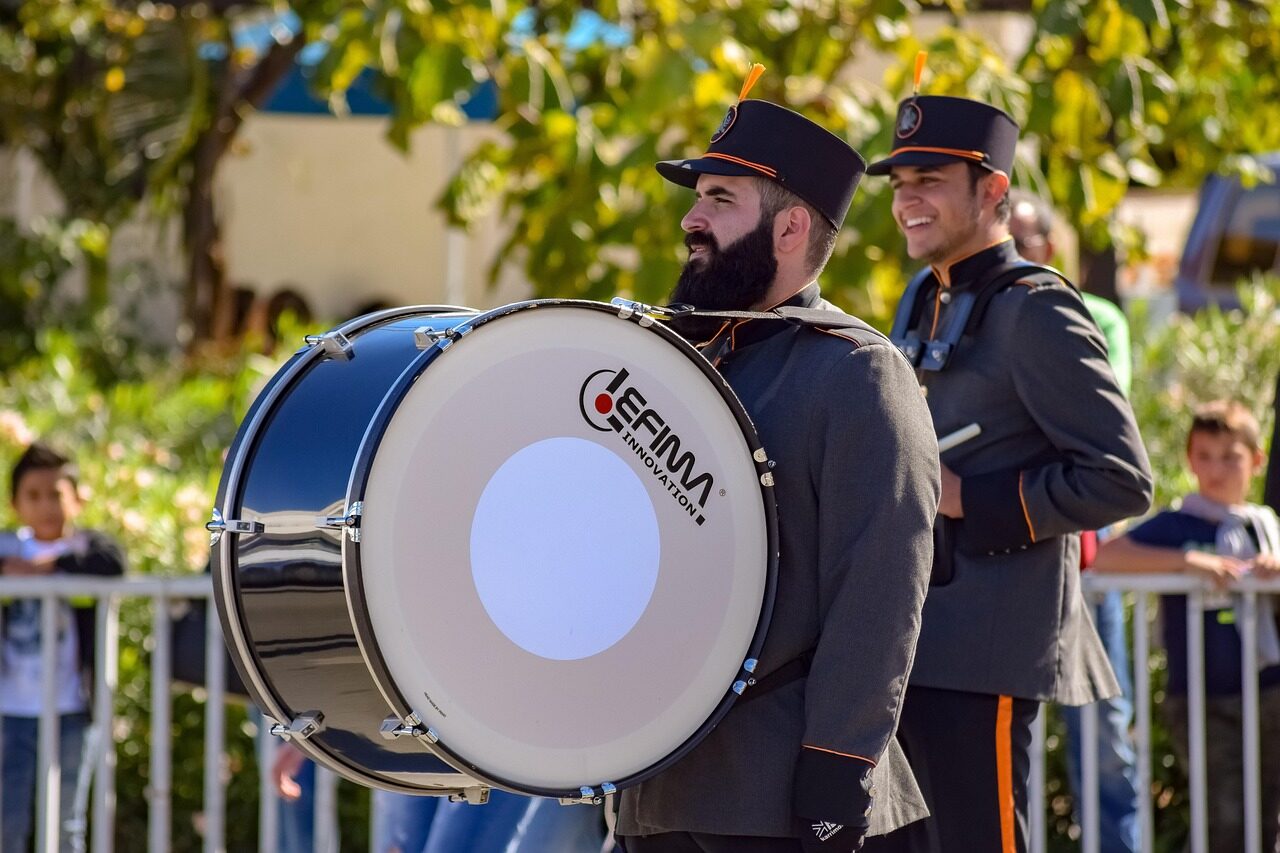
- Battery: The marching percussion, snares, tenors, bass drums, sometimes cymbals, provides pulse and visual impact. They’re the metronome you can see.
- Front Ensemble (The Pit): Stationary percussion at the front sideline, marimbas, vibraphones, timpani, synths, and a galaxy of accessories and electronics. They deliver texture, color, and timing support.
- Color Guard: Interprets the show with equipment (flags, rifles, sabres) and dance. They’re crucial to visual storytelling and GE (General Effect).
Every role is designed to serve the show. You’ll hear staff refer to “music,” “visual,” and “GE” as the pillars that judges evaluate.
Understanding Competitions
Typical Show-Day Timeline
A competition day is a carefully choreographed marathon. You’ll usually see:
- Call time and load: Uniforms in garment bags, instruments cased, props consolidated, Pit gear strapped and labeled.
- Travel: Buses for students, trucks or trailers for equipment. Chaperones take attendance at every transition.
- Warm-up: Body warm-up, music warm-up, then transit to the gate. There’s a timed flow, miss your gate and you risk penalties.
- Performance: Roughly 7–12 minutes depending on circuit. Then it’s straight to post-show water and debrief.
- Equipment reset: Pit and prop crew back to trucks, battery and winds rack instruments, uniforms hung correctly.
- Awards (Retreat): Drum majors or captains represent on the field. After awards, you load out and head home.
Expect downtime between performance and awards. Pack patience and snacks.
Classes, Captions, And Scoring
Competitions group bands into classes by school size or program level (for example, 1A–6A or A/Open/Championship). Some circuits split by enrollment (BOA), others by ability or instrumentation (local circuits vary). Captions are the judged categories, commonly Music, Visual, and General Effect, with specialist awards for Percussion and Color Guard. Scores are comparative, with sub-captions like ensemble music, individual visual, and effect. Timing or boundary penalties can shave points fast, so punctuality and field discipline matter.
Here’s the mindset shift: results are useful feedback, not a verdict on your student’s worth. Judges’ commentary (recorded) helps staff refine the show week to week, which is why you’ll see changes mid-season.
Spectator And Sideline Etiquette
Cheer like crazy, just not during delicate moments. Enter and exit stands between songs or when the drum major’s arms are down. Keep aisles clear for Pit and prop movement. No flash photography at night shows. Silence phones. If you’re volunteering on the sideline, stay invisible: no coaching, no blocking judges’ views, no talking during performances. Treat every band like it’s your own kid out there.
The Pit (Front Ensemble) Explained
What It Is And Why It Matters
The Pit, formally the front ensemble, anchors the soundscape. Mallet instruments carry rich harmonic content that winds can’t always project outdoors. Synths fill out bass or ethereal textures, and auxiliary percussion (think chimes, crotales, cymbals) adds sparkle. The Pit also supports timing, listening back to battery and guiding tempo when wind forms stretch across the field.
If you’ve ever wondered why the opener suddenly feels cinematic, it’s probably the Pit’s orchestration doing heavy lifting.
Gear, Power, And Electronics 101
Front ensemble setups vary, but you’ll often see marimbas and vibes with mounted microphones, a mixer, powered speakers or a small PA, and a synth or two. Power is the lifeblood: heavy-gauge extension cords (12/3), surge-protected power strips, and gaffer tape to secure runs. Some hosts provide shore power: others require a quiet generator. Label every cable on both ends and coil them the same way each time to prevent failures. Keep a toolkit, spare fuses, IEC power cords, 1/4″ and XLR cables, mallet tape, Allen keys, drum key, contact cleaner, and extra batteries for wireless packs.
Sound checks happen in warm-up, not on the field. Balance is set by the audio tech at the mixer. If you’re helping, move with the cart handles, not the bars: never lift a marimba by its rails or resonators.
Safe Load-In, Setup, And Teardown
Safety beats speed. Use multiple spotters on ramps, communicate with clear calls (“Rolling,” “Stopping”), and keep hands away from hinge points. Chock wheels on inclines. Gloves prevent pinch injuries and improve grip. Cables get taped down flat with gaffer (not duct) tape to avoid tripping. During teardown, pack in reverse order of setup, coils secured with Velcro, not knots, so the next show starts clean. If weather turns, cover electronics first, then wood instruments: moisture and keyboards don’t mix.
Logistics, Travel, And Costs
Transportation, Trucks, And Trailers
Your program likely runs a small logistics operation every weekend. Buses move students: box trucks or trailers move instruments, props, and Pit carts. Everything gets road-cased or strapped with tie-downs. Ramps, dollies, and field-friendly wheels save time. Load order matters: what comes off first loads last. Keep a shared checklist on clipboards or a phone app to avoid “Where’s the second synth stand?” five minutes before gate.
Drivers need detailed itineraries with addresses, ETAs, and staging instructions. On arrival, identify truck parking, warm-up zones, and the performance gate. A quick site walk-through prevents chaos later.
Packing Lists, Uniforms, And Instrument Care
Uniforms should travel in labeled garment bags with gloves, shoes, and black socks. Plumes get added near the gate, not on the bus. Color guard should pack base layers that match uniform cut, plus tape and extra bobby pins. For instruments: reeds, cork grease, valve oil, slide cream, extra sticks and mallets, a microfiber cloth, and a small towel for dew. Front ensemble can bring bar covers and keyboard wraps to protect from sun and drizzle. Teach your student to hang the uniform immediately after performances to prevent mildew and wrinkles.
Meals, Fees, And Hidden Expenses
Band fees typically cover instruction, show design, music, props, drill, transportation subsidies, and uniform use. On top of that, expect show-day meals, occasional overnight hotel costs, replacement shoes or gloves mid-season, and consumables like reeds and drumheads. Fundraising helps, but plan a cushion for last-minute costs, an extra pair of black socks, a missing lyre, or gaffer tape runs nobody planned. For meals, carbs plus protein win the day: pasta with chicken, rice bowls, sandwiches with fruit. Avoid heavy dairy right before warm-up.
Weather Plans And Heat/Cold Management
You’ll see everything from surface-of-the-sun September to frosty November. In heat, prioritize hydration the day before, not just the morning of. Electrolytes help: energy drinks don’t. Cooling towels, shade tents, and scheduled water breaks keep kids safe. In cold, thin layers under uniforms work better than bulk, and hand warmers in pockets help guard and Pit members. Brass valves like a drop of lighter oil in cold temps: woodwinds need swabs and extra reeds as humidity swings. Rain plans typically shift equipment staging and cover electronics: shows may go on unless lightning enters the radius.
Volunteering And Communication
Chaperones, Prop Crew, And Pit Crew
You’re the difference between frantic and smooth. Chaperones handle attendance, first aid basics, and bus management. Prop crew assembles big scenic pieces, times field entries, and clears the track quickly. Pit crew moves large instruments safely, sets cables, and protects the audio area. Wear closed-toe shoes, bring a headlamp for night shows, and keep a pocket multitool. The best volunteers are calm, early, and invisible during the performance.
Ask the staff lead how they want field entrances blocked, who calls the countdown at the gate, and where extras stand by. One point person prevents mixed signals.
Chain Of Communication And Common Acronyms
Know the chain. Directors set policies. Staff leads manage sections. Student leaders communicate to members. Booster boards handle logistics and parent communications. You’ll likely use tools like Remind, Band app, or email lists: read everything. If plans change mid-day, trust the official channel, not a group text rumor.
Common acronyms and terms you’ll see: DM (drum major), GE (General Effect), FE (front ensemble), DL (drumline), CG (color guard), ETA/ETD (arrival/departure time), BOA (Bands of America), WGI (Winter Guard International, off-season circuit), MPA/UIL (state assessments), DOT BOOK (coordinate notebook). When in doubt, ask, no one expects you to know it all on day one.
Supporting Your Student’s Success
Nutrition, Sleep, And Time Management
Consistency trumps hacks. Encourage an early night before shows, breakfast with complex carbs and some protein, and steady hydration. Pack snacks that don’t melt or crumble into uniforms, granola bars, bananas, nut butter packs. Time management is half the stress battle: help your student pre-pack the night before, lay out uniform pieces, and charge devices. A simple packing checklist on the bedroom door saves frantic mornings.
Mindset And Encouragement On Competition Days
Your job is to be the calm voice. Avoid last-minute technical advice: that’s the staff’s lane. Instead try, “Trust your reps,” and “Perform for the box and enjoy it.” Celebrate clean effort, not just trophies. If scores dip, frame it as data for improvement. After performances, let them decompress before asking how it went. A quick “Proud of you, what did you feel on the opener?” invites conversation without pressure.
Conclusion
Marching band is organized chaos that turns into goosebumps under stadium lights. Now that you understand the season rhythm, how competitions work, and what The Pit actually does, you’re equipped to help, on the sideline, on the truck ramp, or simply from the stands with a water bottle and a cheer. Show up, listen for the details, and enjoy watching your student grow into the kind of teammate who can move a show and a crowd. See you at call time.
No responses yet